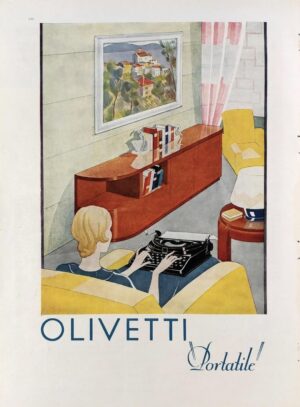
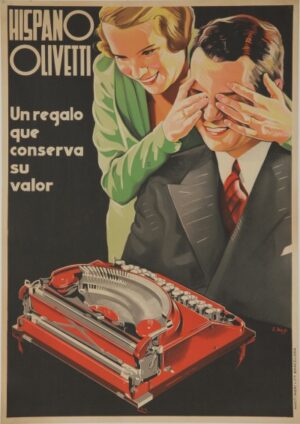
A Typewriter of Elegance
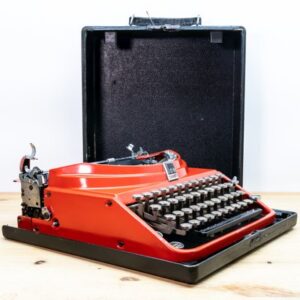 Olivetti typewriters have always been admired for their design, reflecting the evolution of modern art from the early 20th century. The company made ordinary mechanical tools, like typewriters, into emblems of modernism. Camillo Olivetti made a point of hiring architects, designers, and engineers, many enlisted from among the graduates of Italian polytechnics and the Bauhaus. Olivetti once said, “A typewriter should not be a geegaw for the drawing room, ornate and in questionable taste. It should have an appearance that is elegant and serious at the same time.”
Portable typewriters weren’t new. The Blickensderfer No. 5 was the world’s first, marketed in 1893, although it looked little like what we think of as portables today. The Corona 3 (1904) was a small miracle, with a carriage that folded so it could fit inside a traveling case. Remington introduced popular portables in the 1920s that were similarly light and compact, popular with businesspeople, diplomats, and journalists who traveled with their typewriters.
But in 1932, Olivetti introduced a portable typewriter created by pioneering industrial designer Gino Martinoli, with the help of his boss and others at the company. The MP1 (Modello Portatile 1, or “Portable Machine 1”), was intended for both office and home use. In addition to a very traditional and businesslike black, it came in red, blue, brown, green, ivory, and grey. Also known as the ICO (an acronym for “Ingegnere Camillo Olivetti,” commemorating the founder of the company), it was a success from the start, helped by the iconic advertising posters by Xanti Schawinsky, considered even today to represent the best avant-garde marketing of the 1930s. The MP1 had legs, too: it remained in production until 1950.