How the Linotype Machine Created Mass Media
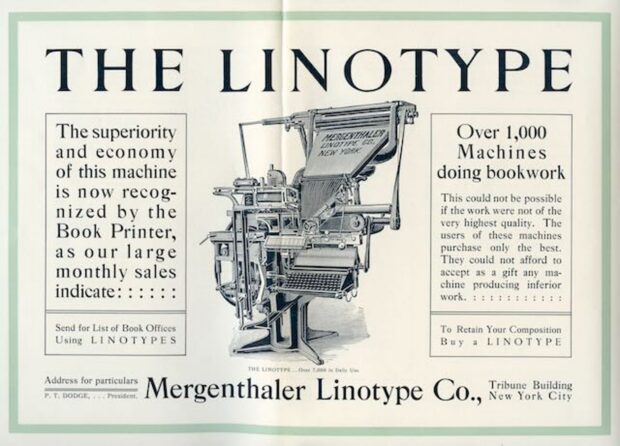
A century ago this year, Ottmar Mergenthaler, a watchmaker trained in Germany who had moved to Baltimore in 1872, was asked by a pair of lawyers to invent a machine to speed up the process of typesetting. (They wanted it for legal briefs.) At that time, type was being set — to produce books, newspapers, posters, etc — by hand, one letter at a time, as it had been done since Gutenberg invented the printing press in 1452. That meant a single page of a newspaper could take two to three days to compose; a single page of a book, a couple of hours.
Mergenthaler wasnt alone. Many inventors were working on this weak link in the publishing process. Thomas Edison invented an electric pen that would perforate paper and create stencils. (It wasn’t successful but became the first electric tattoo needle.) Mark Twain (Samuel Clemons), who had once been a typesetter and was an early adopter of another technological breakthrough, the typewriter, financially backed another invention, the Paige Compositor, which could do the job but was huge and finicky with 18,000 invidivual parts. (When he eventually went bankrupt, Twain described his effort as a “monument of human ingenuity and stupidity.”)
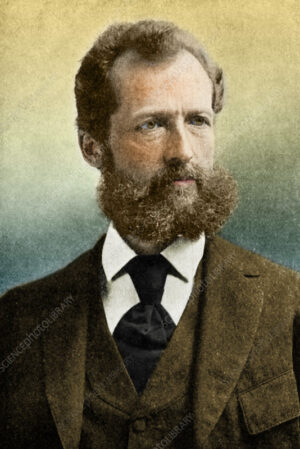
Ottmar Mergenthaler (May 11, 1854 – October 28, 1899). Often called the “second Gutenberg” because of his invention of the Linotype machine, the first device that could easily and quickly set complete lines of type for use in printing presses.
Mergenthaler experimented with several variations on setting type. It’s said that one part of the process–using brass matrices as molds for the type–came from the wooden molds he remembered being used to make German Christmas cookies. After several false starts, he came up with the Linotype machine. The name, which comes from “line-o-type,” refers to the machine’s ability to produce an entire line of metal type at one time. When an operator enters text on a typewriter-like keyboard, the machine assembles the brass matrices in a line. It was known as “hot type” printing because the machine forces molten metal–usually lead mixed with tin–against the brass matrices to cast a single line of raised text, known as a “slug.”
In 1886, the New York Tribune bought one from what was now named the Mergenthaler Linotype Company. By 1900 most large newspapers in the U.S. were using it. For most of the 20th century, it led to an expontential growth of newspapers, periodicals, and books. Mergenthaler’s machine made the era of mass media possible. Linotype machines were used–modified and improved in increments–until the 1980s and the digital revolution (what became known as the era of “cold type”). Recently, journalist and educator Jeff Jarvis published a book called Hot Type: The Magnificent Machine that Gave Birth to Mass Media and Drove Mark Twain Mad. (Bloomsbury Academic) which I’m looking forward to reading.
Mergenthaler didn’t live to see how far his invention would go; he died in 1899 of consumption (as tuberculosis was known) at 45 years old.